Sunday, October 31, 2010

Artist Post 9: Jean Pierre Khazem


Jean Pierre Khazem

Jean Pierre Khazem is a French photographer and performance artist who was born in1968 in Paris, France.   Khazem has published work in many fashion magazines and has photographed for various advertising campaigns.  Khazem has incorporated photography, video work, and performance art into his work for years.  Khazem began displaying his work in exhibitions in 1998.
*I could not find information on his personal life, or schooling.

Khazem photography includes the use of still life and models.  When utilizing models Khazem photographs incorporate the usage of full head masks on his models capturing an unnatural surprising vision.  In 2005, Khazem’s exhibit, “Ladies in Waiting,” at the Chelsea’s Sperone Westwater Gallery consisted of images of models portraying American First Ladies.  Khazem created realistic masks of silicone then obtained the right wig and attire for a model to pose as a First Lady.  Betty Ford, Rosalyn Carter, Nancy Reagan, Barbara Bush, and Pat Nixon were all subjects for Khazem’s photographs in the show.  Khazem stated in regards to the First Ladies, “They are like the mothers of the American people, kind of … my interest in them is only as historical figures.” Props and performance play important roles in Khazem’s photographs.  However, in Khazem’s photographs of the “Ladies in Waiting,” they stand on their own as documentation of a performance. Another well known piece of Khazem’s was his live Mona Lisa (2003), this performance piece featured a nude model wearing a realistic mask of the woman in the famous Da Vinci “Mona Lisa,” standing under a stream of light.  This piece received heaps of attention due to the preciseness of how well the Khazem’s mask, wig, and models posture matched to Da Vinci’s “Mona Lisa.”

Khazem’s models are always performers; the photographs capture their performance.  Khazem stated, “I used masks because I couldn’t bear the acting of models, the way they always pull the same faces, the pout, the glare, and so on. When people put on the masks, they forget their egos. With the mask, the quality of the human comes out.”

I am interested in Khazem’s work, the way his models (figures) appear so stiff and emotionless.  Khazem’s photographs also suggest this playful touch, which is what I am now trying to aim for in my work. 

Book: Photo art: photography in the 21st century, 2007, New York, Aperture

Most recent exhibition: 2008 Teleport Fargfabriken- Fargfabriken Norr, Ostersund

Interview: I could not find one.


Jean- Pierre Khazem, Untitled V14, 1999
30.5 cm x 40.5 cm, Lambda on Crystal Archive

Jean- Pierre Khazem, Briquet, 1999
30.2 cm x 40.5 cm, Lambda on Crystal Archive


Jean- Pierre Khazem, Broadway, 1999
40.7 cm x 30.5 cm, Lambda on Crystal Archive

Jean- Pierre Khazem, Mona Lisa 2, 2003
47.2 in x 32.5 in, C- Print

Jean- Pierre Khazem, Omaha beach 2, 1998
55.9 in x 40.2 in, Color Photograph
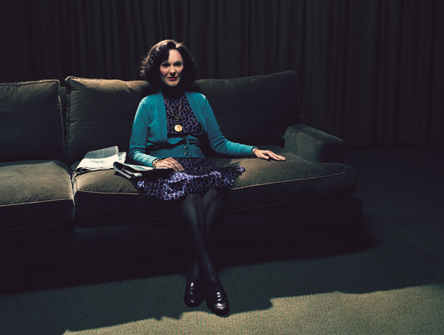

Jean- Pierre Khazem, First Ladies: Rosalyn, 2004
62 x 47 7/8 in., C-Print on Fuji Flex Paper


Works Cited

Jean Pierre Khazem biography. Blank England.  30 October 2010. <http://blankofengland.com/Jean_Pierre_Khazem/Jean_Pierre_Khazem_Biography.html>.


Jean-Pierre Khazem: First Ladies. The Gross- Michael Foundation.  8 July 2006. 30 October 2010. <http://www.artinfo.com/galleryguide/exhibition/12247/737/94028/jean-pierre-khazem-first-ladies/>.


Shields, Kathryn. Jean-Pierre Khazem: First Ladies Gross Gallery.  29 October 2010. <http://www.artlies.org/article.php?id=1415&issue=52&s=1>.

Sperone Westwater: artists.  Jean-Pierre Khazem: works.  30 October 2010.


Wednesday, October 27, 2010

Idea 9: Superimpose


Superimpose

tr.v. su·per·im·posed, su·per·im·pos·ing, su·per·im·pos·es
1. To lay or place (something) on or over something else.
2. To add as a distinct feature, element, or quality: superimposed her own interpretation when she retold the story

: to place or lay over or above something <superimposed


For my project I have been superimposing objects to make specific scenarios.  To superimpose is to place or layer something over something else, relating to photography specifically, would be placing an image on top of an already existing image to change the overall effect.  Recently I have been wondering if I should try layering more images or objects over or (in) my pictures to make them more dynamic.  After looking at Tierney Gearon’s double exposed work, I have become interested in the idea of possibly adding more layers to my over all image.  By adding a semi- transparent layer of me posing and acting out current reoccurring situations, then placing it over a similar scene in the doll like setting could possibly make my work more dynamic.  

Sunday, October 24, 2010

Artist Post 8: Tierney Gearon

Tierney Gearon

Tierney Gearon was born in 1963, in Atlanta, Georgia and is an American photographer.  Gearon never attended art school but began her career as a ballet dancer and model, and was shortly discovered by an agent in Paris for taking impressive photos of her fellow models.  Later Gearon became a fashion photographer, taking photos for the influential fashion houses and producing work for Times Square Ads.  After five years of working as a fashion photographer, Gearon married a Frenchman and had two children.  When Gearon and her husband divorced Gearon started a very personal project (I am a Camera), which documented her family. 

In 2001, Gearon’s exhibit, I Am a Camera, was at the Saatchi Gallery and consisted of large blown up photographs of Gearon’s two children.  There were many complaints about the nude photographs of Gearon’s children and London police eventually demanded that the work be removed. Gearon said in reference to her work at the Saatchi Gallery being criticized, “I think that the pictures are incredibly innocent and totally unsexual. I don't crop them, I don't retouch, and the shots are never staged. I might introduce an element, like a mask, to a given situation, but I would never insist that the child put it on.” (Gearon- Guardian)

Gearon takes photos of her children during everyday life and according to Gearon in reference to her work, “It’s not a business for me. My work is like a diary. I do it for my soul.”

Tierney Gearon in her series Explosure, created beautiful prints by layering double exposures. Gearon said, “Two boring images suddenly become more interesting than a regular photograph.”  (West) Gearon in this series often combined themes that contradict each other, combining indoor images with outdoor images and youth with elderly.  Gearon’s grouping with the photographs is fascinating and makes you study the work longer to discover where one picture begins and where the other picture ends. Gearon’s Explosure work fascinates me because there are so many layers to each photograph making them busy yet playful. I am interested in Gearon’s work and feel that it may be beneficial for my work to make it more playful.

In 2006, The Mother Project, a personal project of Gearon’s was the subject of a documentary film by directors Jack Youngelson and Peter Sutherland.  Gearon now has four children and is working on a series of children’s book, as well as working on a variety of different campaigns.  Gearon currently lives and works in Los Angeles.  (20x200)

Tierney Gearon’s daughter said in reference to photographs, “You can have pictures for ages and ages and you’ll always remember, that’s what pictures are, there memories.”


Interview: I couldn’t find an interview with Tierney Gearon however I found this youtube video of her and her children talking in reference to “The Mother Project” (film). http://www.youtube.com/watch?v=TWCBvuQpjIU

Book: Daddy, Where are You? By Tierney Gearon Publisher Steidl, Gerhard Druckerei und Verlag, published October 2006.

Most recent exhibition: Explosure, Philips de Pury & Company, 2008/ ace Beverly Hills, 2009.


Tierney Gearon, Explosure
Untitled, Frame 18, 2008 Archival Print 42 x 53in. 

Tierney Gearon, Explosure
Untitled, Frame 50, 2008 Archival Print 42 x 53 in. 

Tierney Gearon, Explosure
Untitled, Frame 12, 2008 Archival Print 42 x 53 in.

Tierney Gearon, I am a Camera
Untitled, Archival Print,
 (print size can't find, however i know she prints on a large scale)

Tierney Gearon, The Mother Project 
Untitled, Archival Print?
 (print size can't find, however i know she prints on a large scale)


I added the photograph below to show how she plays with different scales.

Tierney Gearon, (for an fashion ad)
Untitled, unknown


Works Cited

Gearon, Tierney.  The Guardian. 13 March 2001. 24 October 2010. <http://www.guardian.co.uk/society/2001/mar/13/childprotection>.

Tierney Gearon Bio. <http://www.tierneygearon.com/bio/>.

West, Naomi.  Tierney Gearon: double exposure.  2 January 2009.  24 October 2010. <http://www.telegraph.co.uk/culture/photography/4014998/Tierney-Gearon-double-exposure.html>.

Tierney Gearon. Wikipedia. 7 August 2010. 24 October 2010. <http://en.wikipedia.org/wiki/Tierney_Gearon>. 

Tierney Gearon. 20x200: It's Art for Everyone. 24 October 2010. <http://www.20x200.com/artists/tierney-gearon.html>.

Wednesday, October 20, 2010

Idea 8: Dolls


Dolls

The definition of doll is:
–noun
1. a small figure representing a baby or other human being, esp. for use as a child's toy.
2. Slang. a. a pretty but expressionless or unintelligent woman.
b. a girl or woman, esp. one who is considered attractive.
c. a boy or man who is considered attractive.
d. (sometimes initial capital letter ) an affectionate or familiar term of address (sometimes offensive when used to strangers, casual acquaintances, subordinates, etc., esp. by a male to a female).
3. Informal. a generous or helpful person: You're a doll for lending me your car.

Dolls represent human beings.  Archaeological digs have found remnants of dolls showing that dolls have existed since the beginning of mankind. Most recently in my work, I have become interested in making the figures (me) in my photographs give the impression of being a doll. Because I am working in a small scale setting (doll house) I figured it would be most interesting if I became visible as a doll with in the doll house.  I am attracted to dolls because of their stillness and how peaceful they appear. Most dolls are designed as toys.  Children play with dolls stimulating their imagination and role playing allowing them the freedom to create their own unique stories. Dolls began as toys but were often also used in religious ceremonies, as well as in folk art cultures.  Today many dolls can be acknowledged as art.


Works Cited

Dictionary.com 20 October 2010. <http://dictionary.reference.com/browse/doll>.

Wikipedia. Doll. 20 October 2010.  18 October 2010. <http://en.wikipedia.org/wiki/Doll>. 

Sunday, October 17, 2010

Artist Post 7: Ruud Van Empel


Ruud Van Empel

Ruud Van Empel born in 1958, in Breda, The Netherlands graduated in 1981, from his hometown school, the Academy of Fine Arts St. Joost.  Empel began his career as a designer but focused mostly on film and photography.  Empel takes and collects pictures of models, leaves, flowers, plants, etc putting them in a database.  Empel when editing his photographs (mostly in Photoshop) uses these images that he collects to produce superior collage encouraged photos.  According to Empel in reference to his work “Coincidence is very important in making collages, I photograph all kinds of things, just following my fascinations, later these photo’s happen to come together in one collage. Sometimes it takes years for a photo to get into my collages, lots of photo’s I take never get in.”  (Interview)

Empel describing his work states, "I use one model's forehead, then another one's nose, then I add on light to the nose and the pupils in the eyes. I'm just mixing, mixing, mixing. Even the upper and lower lips are separate montages." He is creating a mosaic of facial features to craft a unique imaginary individual. (Paris)

Empel enhances images making them appear dreamlike and painterly.  The characters in Empel’s photographs display as doll like characters.  I am interested in Empel’s work, the way Empel edits his models giving the impression that they are doll like and fragile.  In my work I want to try and expand on this idea of making myself appear more delicate and doll like by editing and exaggerating certain features. 

Rudd van Empel’s work often consists of young children in tropical forest settings.  Empel finds leaves and flowers intriguing and captivating because of this he places his models in these tropical like settings.  Empel has produced a new kind of collage photography.

Empel’s work negatively scrutinized in the past for how dark the children (African Children) are in his compositions challenges this inquiry.  Empel states, "When people think of childhood innocence they automatically think of a white girl with pale skin, which is strange because all children - whether they're black or white - are the same. And in Christianity, the colour black is often used to express something negative. The devil is black; death is black. I wanted to challenge these conventional perceptions and show that a black child can also represent beauty."  (Ruud Van Empel)

Ruud Van Empel, Generation #1 2010, Panorama Works
Cibachrome 49 x 130 inches

Ruud Van Empel, World #1 2005
Cibachrome, 41.34 x 59.06 inches

Ruud Van Empel, Untitled #1, 2004
Cibachrome, 33.11 x 46.81 inches

Ruud Van Empel, Brothers & Sisters #3, 2010
Cibachrome 47 x 47 inches


Book: Ruud van Empel Photoworks. January 2009. Published by PhotoWorks.  Amsterdam text by Maartje van den Heuvel. 

Current Exhibits:

Flatland Gallery, Utrecht, The Netherlands, Solo Exhibition “Wonder” October 30- December, 2010. 

Paris Bejing PhotoGallery, Bejing, China, Solo Exhibition December 11, 2010- February 1, 2011. 


Samson, Anna.  Galerie Rabouan- Moussion Paris Review. http://web.ruudvanempel.nl/publications-press/reviews/245-exhibitions.html

Ruud Van Empel. 16 October 2010.  2010. <http://web.ruudvanempel.nl/home.html>.

Ruud Van Empel.  16 October 2010.  14 May 2010. <http://en.wikipedia.org/wiki/Ruud_van_Empel>. 

Friday, October 15, 2010

Competition Entry #1

I entered the Photographer's Forum magazine competition. Here's proof and the images i entered.